I went to yoga this morning, and damn, it was warm in that studio. We’d barely reached cat-cow warmups and I was already perspiring. Granted, my internal thermometer has recalibrated since a few months ago, when apparently I began to enter the wonders of mid-life. I used to be able to walk/jog for 45 minutes and barely break out in a glow. Not today. I was praying we wouldn’t attempt any quick twists that might turn me into a Rain Bird sprinkler. When our benevolent torturer, I mean, instructor suggested a pose that I’m not even sure Patanjali knew, I reached for a towel to wipe my face and took a breather. As I caught back up with the class in the next pose, our yogini gently reminded us that fidgeting is a sign of an unfocused mind. Adjusting our tops or brushing hair out of our eyes is just a way to not stay in the pose. And if instead we learned to stay, it could bring us many benefits in life.
I agree with her. Mostly.
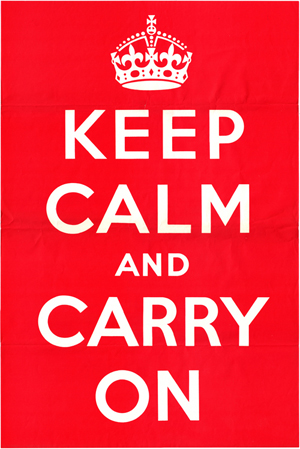
Not running from the difficulties and annoyances of life is typically a good sign of maturity. We teach our children to stick with their algebra homework because we know that, in the long run, they’ll learn more—about themselves and life—than what’s on the page. We want life partners who won’t file for divorce when the dogs get skunked three times in one year (sorry, h oney!) And we need professionals in every line of work who can slog through problems and find solutions that make this a better world for all of us. When we choose to override our desires in service of something bigger than us, something more meaningful, that’s a good move. Think “keep calm and carry on,” the British motivational slogan during World War II, which ironically is now paraphrased to market every indulgence in the world. That said, fortitude is definitely a virtue. Until it’s not.
Sometimes it’s just ego masquerading as true grit. Look how strong I am, look how brave I am. I’ve seen so many people stick with a job that’s a bad fit because they don’t want to go back on their word, or be seen as weak, disloyal or not committed enough. Yep, I’ve done that and stuck with a role long enough that I thought I might be committed. I thought I should’ve been able to handle it.
Of course, I’ve also put my head down and plowed through because I didn’t know any other way. “Walk it off,” “suck it up,” and “stiff upper lip” were the bylaws of our family. My parents were doing the best they could with what they knew, but unfortunately staying was a euphemism for “stuffing it.” So it became my factory setting. In fact, it was so ingrained that I started to believe that if something wasn’t challenging then it wasn’t worthy. Life itself became a matter of delayed gratification. Self-care was frivolous.
When I was 24 I decided to take a second stab at a masters in music and moved 2,000 miles from San Francisco to Minneapolis to attend the University of Minnesota. No friends, no family, no job, totally different climate—a huge leap of faith. And of course, getting a masters in music performance is no assurance of a career. But I thought it was my calling, a gift I was meant to pursue. When I moved, I met with challenge after challenge: I broke my lease after two days, and forfeited $1000, because I discovered I needed a safer neighborhood; I learned I would not be studying with the masters-level flute instructors and would instead be assigned to the undergraduate teacher (but still pay masters-level tuition, ahem); the job I’d found was “downsized” to less than part-time; I took a series of temp jobs that drained me; I had daily migraines; I wasn’t able to feel connected in my new church community. Other people seemed to be able to handle situations like this so I should, too. I thought it was my path in life, and I just needed to find a way around the hurdles. Weren’t these just tests along the way? Or was I ignoring both the signs of the universe and those of my own body that said it was time to go in another direction? After eight months of determination and a near breakdown, I moved back home to start over. For me, the bigger leap of faith was changing direction, even when I didn’t know what that direction was.
So if staying isn’t always the answer, how do you know when to hold ’em and when to fold ’em? Here’s what I’ve figured out so far:
- Is there some sort of a “should” involved? Shoulds and shouldn’ts don’t get a vote. I have to go deeper into a place of calm reflection to hear what I truly want in a situation. And not what I don’t want, but what I do want. I sit with that question until I can define it in a way that resonates with me.
- There’s more than one way to stay. In my Minneapolis example, what I’d really wanted was to find and live my life purpose. I thought the obvious answer was to continue my music studies; I loved playing, expressing myself through music, and I loved studying—and was good at it. My error was in assuming that a master’s in music was the only gift I had to give, the only way to stay with that intention.
- Am I sacrificing self-care for staying power? When I tell myself at 11 p.m. that I just need to get through five more emails before I go to bed, I’m not doing anyone any favors. Studies show that we are more productive when we take care of ourselves.
- Does the urge to stay feel like “shackles on” or “shackles off?” This is the test Martha Beck outlines in her fabulous book “Finding Your Own North Star” and it helps me confirm or deny the previous steps. If I have a visceral reaction—however slight—that choosing to stay feels like my shoulders hunching forward and my head tucking down, I need to consider other options. If choosing to stay feels calm and unfettered, regardless of the challenges I know I may face, then that’s the path I take. For now. When situations change, I come back and go through all the steps again, even if it’s just the next day.
So back to yoga. When I broke the pose, was I being lazy or attending to self-care? Probably a little of both, to be honest. What I know is that at this point in my life, I need to exercise the muscle of self-care, because it’s atrophied. So I consciously chose to break the pose to let my body know I will no longer ignore its messages. And over time, as both my staying muscle and self-care muscle become equally matched, I will expand my range in all directions.
 that’s my new motto. I’m also a huge fan of Anne Lamott who said, “You own everything that happened to you. Tell your stories. If people wanted you to write warmly about them, they should’ve behaved better.” Amen, sister.

 InSight Ministry