(Sermon on April 9, 2017, Palm Sunday, at Umstead Park United Church of Christ)
Meditation passage
It is a basic principle of spiritual life that we learn the deepest things in unknown territory. Often it is when we feel most confused inwardly and are in the midst of our greatest difficulties that something new will open. We awaken most easily to the mystery of life through our weakest side. The areas of our greatest strength, where we are the most competent and clearest, tend to keep us away from the mystery. —Jack Kornfield
Scripture:
Mark 14:32-42 New Revised Standard Version (NRSV)
They went to a place called Gethsemane; and he said to his disciples, “Sit here while I pray.” He took with him Peter and James and John, and began to be distressed and agitated. And he said to them, “I am deeply grieved, even to death; remain here, and keep awake.” And going a little farther, he threw himself on the ground and prayed that, if it were possible, the hour might pass from him. He said, “Abba, Father, for you all things are possible; remove this cup from me; yet, not what I want, but what you want.” He came and found them sleeping; and he said to Peter, “Simon, are you asleep? Could you not keep awake one hour? Keep awake and pray that you may not come into the time of trial; the spirit indeed is willing, but the flesh is weak.” And again he went away and prayed, saying the same words. And once more he came and found them sleeping, for their eyes were very heavy; and they did not know what to say to him. He came a third time and said to them, “Are you still sleeping and taking your rest? Enough! The hour has come; the Son of Man is betrayed into the hands of sinners. Get up, let us be going. See, my betrayer is at hand.”
Garden-Variety Prayer
This is the Sunday in Protestant churches where some pastors cram the entire emotional rollercoaster of Holy Week into just 17 minutes. Or less. It’s like offering a Passion week sampler platter, where you get a little bit of the triumphal entry into Jerusalem, the Last Supper, the betrayal, the trial, the crucifixion.
Since I’m not a pastor and I don’t play one on TV, I chose a different route: tie my message into the topic of the forum that I’m facilitating after service. I may be liberal in my theology, but I’m conservative when it comes to my energy.
And since I am talking all about prayer today, I thought you should know a little of my background. My first memory of praying was when I was about 8 or 9 years old—a little older than most. I was the last of three children, born 9 years after my sister and almost 7 after my brother. Over the years, Mom had fought the good fight in trying to get the whole family to go to church. But after I came along, she followed her life-long calling– to be a latent agnostic. I’m not saying there was a direct cause-and-effect relationship between my birth and her “calling.” Just saying I didn’t go to Sunday school or learn the way others did. While my friends were going to catechism and making their first communion, I was making up my own prayers on Sundays. “God, please, please, for DAD’S SAKE, PLEASE let the Oakland Raiders win today so he doesn’t have a heart attack!” In church language, I believe this qualifies as some lesser-known subset of intercessory prayer. And so began my deeply devout journey on the inner mysteries of communicating with God …
If you’d told me back then that I’d be standing here today talking about one of the most intense, mysterious, multi-layered, sacred moments of prayer in the Christian tradition … I can only say that this is proof that God has an incredible sense of humor.
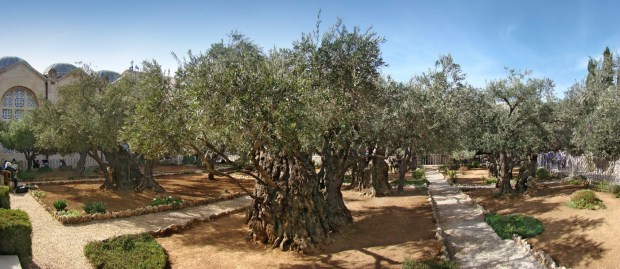
At the beginning of today’s service we celebrated with the children what’s often called “Jesus’s triumphal entry into Jerusalem” for the Passover. Now we fast-forward to the night of Holy Thursday, after the Passover Supper. Jesus and a handful of disciples decide to take a walk outside the city walls of Jerusalem to go pray in the Garden of Gethsemane. Gethsemane was one of his favorite places to pray when visiting the Holy City, which is why Judas would, later that evening, know where to find him to hand him over.
So why go out beyond the city walls to pray? Why at that moment? The tension between Jesus’s reform movement and the religious authorities had been running very high. Keep in mind that Jesus and his followers were one of a number of Jewish reform movements at the time. The Pharisees, the religious authorities, were trying to hold onto a vision of Judaism that was under constant threat from the OUTSIDE by Roman rule. And at the same time, they were trying to keep a steady stream of liberal-minded reform movements from fracturing Judaism from the INSIDE out. This week, this week of Passover, is the week that all parties—the Roman governor, the Pharisees, Jesus and his followers—have made their way to Jerusalem. It’s a bit of a tinder box.
So Jesus and the disciples, they arrive in the garden, and he asks the disciples to remain there and stay awake. He doesn’t ask them to go find the betrayer or convince the authorities to back off. He doesn’t ask them to go find a second house where they can hide in an undisclosed location. In fact, he doesn’t ask them to DO anything. The time for doing has been faithfully fulfilled in the hours before. This is the time for being. He says essentially, “I’m gonna go over there and pray—be with me in prayer.”
As a society, we tend to measure everything by goals and accomplishments. We want outcomes, results, progress, forward movement. We want to HELP, oh lordy do we want to help. Sometimes the help is good and is what’s needed. Sometimes helping is merely our own ego’s way of checking the box that we did something. In our Western world, we see action as strength, and perceive “inaction” as weakness. Let’s be honest: “being with” is not easy. It takes practice. It takes prayer. It requires first an ability to be with our own moments of pain, our own times of ambiguity, our own frustration – so that, later on, we can be there for others. Prayer is a muscle we have to build like any other muscle. We gradually strengthen our willingness to override our ego, our intellect, and say, there’s an opportunity for something bigger to be present in this in-between place. On the outside, this “being with” looks like the most passive thing in the world to be NOT-doing at such a critical time. Our egos say, don’t just sit there—do something! Jesus says, “Sit there and pray.” The reality is, it’s the most intensely active, counter-cultural, life-affirming thing we can do. When we choose to BE WITH ourselves and others during deeply troubling times, we have an opportunity to be channels of fierce grace. Fierce grace. Fierce grace says, I BELIEVE IN A UNIVERSAL interconnected web of love that’s so much bigger than me. It’s even stronger and more pervasive than what I see, hear, and feel around me. And because I believe this, I choose to BE first so I know better what to DO. We quiet our minds and hearts and see what’s present here, in THIS moment. What’s needed right now? And most importantly, we ask, what is mine to do? Not, why aren’t those people over there doing more or doing better. What is MINE to do? We need A LOT of fierce grace in this world of ours right now.
As Jesus prays, he acknowledges that God is all-powerful, God can do anything. He understands that God can work in unexpected ways. And so he asks for what he wants—that the suffering and brutal path ahead may be altered—but ultimately he says, “Not what I want but what you want.” And then he listens. I once heard someone describe prayer as listening for the heartbeat of God. This is how Jesus syncs his own heartbeat with God’s.
Here’s what he might have been listening for: how does he oppose the powers of injustice and oppression without hate and violence? What is his part to do, this day, if his opposition colludes with a Roman governor (aka, foreign agent) to decide his fate? What if all the good he has been trying to do could now be undone? Was that all in vain? Had he heard wrong back then? Was he supposed to do something or be something different now? What about all those people who expect him to save them from an oppressive regime? What if he’s not sure whether his fellow believers have the spiritual fortitude to persevere, to find their way through?
Maybe that’s too much of a stretch for us in 2017 to imagine or understand how that might have weighed on his mind.
It must’ve been a tad more than frustrating to return from his prayer and find Peter, James, and John sleeping. In the midst of confusion, chaos, and sadness, we often have two speeds: full-on DOING, or hopelessness and helplessness. Our minds become heavy with grief, and we essentially fall asleep. Often that happens when we stay in our heads too long, worrying about all the events of the world and in our lives, without taking the time to ground ourselves in something bigger. Deeper. So, although our spirits are willing, our flesh—our prayer muscle—is weak. We haven’t practiced BEING WITH. And in our self-induced trance, we close our eyes.
“Can you not stay awake with me an hour? Stay awake and pray that you may not enter into the time of trial.” In other words, pray that we may not be tempted to give in to rash, knee-jerk reactions. Pray that we may not try to help in the wrong way. Pray we’ll know what’s ours to do. Pray that we don’t inadvertently do something we might later regret. Like resorting to violence so that we feel better for at least DOING SOMETHING. Or like running away and shutting ourselves off while innocent people are tortured and killed.
And there’s another kind of temptation we need to avoid. It’s dangerous for any of us to conclude definitively what is and is not God’s will. If God’s will looks repeatedly like what we personally believe, we’ve made God too small. And that is true even when we’re fighting for truth and goodness, even when we’re trying to protect the marginalized. What Jesus shows us is that even when our deepest desire is peace, radical equality, and love, we can’t make an assumption about how that should play out. I’m not suggesting that God’s will is EVER for people to suffer. I don’t believe that. I don’t believe in that kind of God. I believe in a God that is bigger than we can ever imagine, a God who can work through a broken humanity even if the midst of the worst of times.
That’s why, unlike my first attempts at prayer in childhood, we don’t for God to DO SOMETHING. We don’t pray to change God’s mind. We pray to change ours. We ask that we can be responsive, willing, courageous to follow wherever life leads. We pray to know the difference between what’s ours to do and what’s not. We pray we’ll understand when it’s time to BE WITH, when it’s time to act, and when it’s time to let go of our own agenda so that something bigger might take shape. We pray to stay awake and open to possibilities. Because that’s where fierce grace lives.
“Can you not stay awake with me one hour?” —God asks this of us, today, too. I’d like to invite you to join me in a little practice, a little muscle building. Rather than an hour, will you join in three minutes of silence? For all of you with young ones who are suddenly nervous about whether you need to run to the nursery, please know that silence has never been about the absence of sound. It’s a posture of our heart. Sometimes, in the midst of silence, the most wonderful thing we can hear is the cry of a baby or the whisper of a child. It’s all good. And as we pray, I encourage you to lean into the fact that you’re surrounded by a whole community where everyone is actively engaged in BEING WITH.
At the end of three minutes, David will begin playing the intro to our chant. We’ll remain seated. The choir will begin to sing, and I encourage you to listen for the moment when it seems like it’s your time to begin singing. Or humming. There is no wrong answer. And your time to join may be different than the person next to you.
So now… Will you stay awake and pray with me three minutes?
 InSight Ministry