Breaking News: Spiritual Fanatic Urges Anti-Social Behavior

If you could get an extra hour of free time every day, what would do with it? No, really—let’s pretend the space-time continuum has just been rearranged, and physicists tell us we get about an hour more each day. How would you spend it?

Ok, here are some other questions:

If you learned that a couple friends were—without your knowing—tracking your everyday, fairly boring habits, as well as your likes and dislikes, so that they could manipulate you, would you care? (As long as the manipulation is subtle and not overt, is that ok?) Would it matter if they found some weird way to make a gabillion dollars off this ability to subtly manipulate you, without you realizing it? How about if they shared this scheme with others so that they, too, could manipulate you and make money off you, would that matter?

Just a few more questions—because we have that extra time, y’know.

Do you wish there were a way to reduce the polarization in our country? Do you want something you can do, individually, to decrease the generalized tension and divisiveness? Something that could help “both sides” agree on factual information and get less caught up in “I’m right, you’re wrong” stand-offs?

There is a way to get about an hour of time back, to stop others from manipulating you and your friends, and to do something that builds more “us” and less “them.” Be anti-social. Stop using Facebook and other social media. Even for goodness.

It really doesn’t matter if we’re posting cat videos or spiritually uplifting content. In fact, the sweeter, the funnier, the more “like-able” our posts, the more we perpetuate the cycle. In fact, just showing up to browse—even if you don’t post—contributes to the problem. By the nature of Facebook’s business model, our online participation in any way, shape, or form allows us to be unwitting accomplices in a milieu of manipulation. (But if I like it, can it really be bad for me?)

Meanwhile, here’s how our seemingly insignificant social media habits affect us.

Let me be clear: I don’t believe social media is evil. I do believe that like so many other things in life, we’ve talked ourselves into using something because it seems innocuous and because we think we can counteract any of its downsides. Those negative effects don’t apply to us, just others. We’re better than that. Besides, we only spend a little time on social media; it’s not like we’re addicted or anything. (We may be distracted and unfocused, but dang if we don’t have the ability to churn out rationalizations in the wink of an emoji.) I don’t need to be convinced by others who engage in amazing social media experiences. I’m happy for you. I conducted my own non-scientific experiments to track my sense of purpose and well being. I was very mindful of what kind of content I posted, how I engaged, how much time I spent. Sure, I had some good interactions occasionally. But overall, the return on investment was not worth it.

From my perspective, social media directly thwarts the values I want to nurture in myself and others: deep listening, contemplation, humility, equanimity, and personal connection. The technology itself rewires our brain functioning, countering both the spiritual purpose as well as the secular, beneficial side-effects of meditation. I prefer thoughtful, nuanced pieces that make me think, rather than hyped-up headlines (like the one I purposefully created for this blog) and echo-chamber content. I can access the content I want online in other ways. The business model makes money off gorged egos, individual and collective. So much so that even when we engage for positive purpose it nonetheless subtly, surreptitiously cloaks our egos in faux furs of virtue. We’ve convinced ourselves that sharing content that results in hundreds of hearts and thumbs-ups is the same as changing hearts and minds, which it is not. And finally, because I’m a bi-vocational minister, I need to be stingy with my time. I want to align my personal values to the way I spend this one wild and precious life.
mental-2301393_1920


Spirituality for Borderline Times

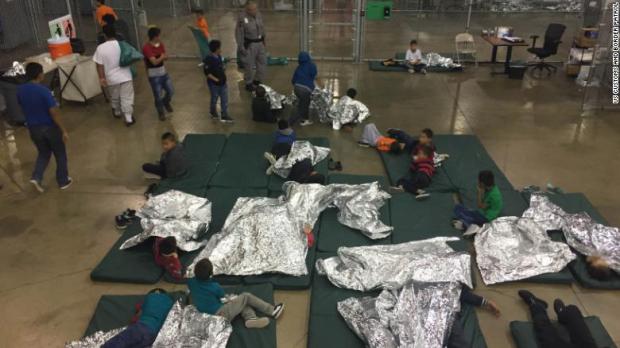
I don’t have words for the crises (yes, plural) on the border. I don’t. I’ve tried. In my disbelief, the best I’ve been able to do is to keep myself from despair and numbness. It’s like trying to stave off frostbite of the soul. I don’t know the answer to the problem, but I do know that slipping into overwhelm disables hope of finding … well, hope. Sometimes the best I can come up with is what I will not do, what I will not settle for.

I’m tired of people saying, “This is not America.” It may not be the America many of us aspire to—fair enough—but to suggest this is not who we are flies in the face of reality, past and present. We can’t fix a problem we’re unwilling to claim. It is indeed America, and it’s not the first time we’ve separated children from their families. In the founding of our country, slave families were often split as slave mothers, fathers, children were sold or “given” to other slave owners. From the late 1800s up through 1970, the US government stripped Native American children from their families and sent them to “Indian boarding schools” so that the US could “Americanize them.” Capt. Richard H. Pratt, founder of one of the schools, stated their purpose was to “kill the Indian and save the man.” During the Depression era, Mexican families on the borders were considered threats to American jobs and forced out of the US, often separating parents and children. Then we have the xenophobia of WWII where our government interred thousands of Americans of at least 1/16th Japanese descent, including children under the age of 10 and the elderly and physically challenged. Up through today, we also have the practice termed Jane Crow, where single mothers of color are more likely than white single mothers to have their children forcibly removed from their homes by government agencies and put into foster care.

We cannot keep lying to ourselves. Nor can we look away and claim we cannot bear to watch this current situation play out. The world is too dangerous for us to turn our heads.

180618180006-mcallen-detainees-floor-exlarge-169This is a time when spiritual warriors for peace and mercy need to step into their calling. We must train for these periods in time by not shying away from the horrors of inhumanity. We sit with the pain, the injustice, the cruelty so that we can be more effective in confronting them. Just as the Student Nonviolent Coordinating Committee trained Civil Rights workers in the philosophical and tactical practices of nonviolence modeled by Mahatma Gandhi and others, we resist knee-jerk reactions of verbal and physical violence. We won’t give in to the temptation to demonize even the perpetrators of injustice. We ground ourselves by practicing compassion in the midst of cruelty. And because of this training, we can then step onto the front lines to embody a different way of being.

In a recent episode of On Being, host Krista Tippet spoke with Rami Nashashibi, founder and executive director of the Inner-City Muslim Action Network in Chicago, and Rev. Lucas Johnson, coordinator of the International Fellowship of Reconciliation, the world’s oldest interfaith peace organization. Both are committed to the spiritual discipline of nonviolence. Johnson recalled a moment that Civil Rights leader A.J. Muste experienced: “Another moment for A.J.. Must was, he was demonstrating on a picket line and the reporter came up to him and said, ‘Mr. Muste, do you believe that your demonstrating will change the country?’ And he responded by saying, ‘Young man, I’m demonstrating so that my country doesn’t change me.’ And so I think there’s this place where we have a responsibility to hold to the power of love that we know to be true and to not allow the world around us to deaden that in ourselves. And I think it’s really tempting. And not allowing that to die in ourselves is a part of what enables us to engage others in that way, but it’s a real struggle.”

The following intercessory prayer is from the Archdiocese of Chicago’s Office for Immigrant Affairs and Immigration education:

For the children who are US citizens, but live in fear of broken families because of the undocumented status of their parents, that God may bring them Hope as we work toward conversion of hearts and minds. Let us pray to the Lord.

For the teens and young adults who were brought to this country as children and have now been deported to a country they barely know, that God will be with them and guide them to reunite with their families. Let us pray to the Lord.

Recalling that Our Lord told his disciples to “let the children come to me,” that we may welcome the children of immigrants and work to provide security and dignity to the lives of their families, we pray to the Lord.

For the immigrant children who have known only this country and work hard at school, that they may know the value of their work through the support of the DREAM Act, we pray to the Lord.

For immigrant families, suffering in the shadows from poverty and brokenness, may God bless them and protect them as we all work for a reform of the immigration laws. Let us pray to the Lord.

For immigrant families searching for life and dignity, that they may find it wherever God leads them as we work together for conversion of hearts and minds. Let us pray to the Lord.

For the immigrant that faces rejection and pain in this country, that they may know the value of their life and work no matter where they live, and that they find a welcoming community here in this country. Let us pray to the Lord.

Recalling the fear that the disciples felt after the death of Jesus, may the immigrant in this country come to know the power and strength of the Holy Spirit through our welcoming embrace. Let us pray to the Lord.

That by seeing God’s presence more clearly in every human life, we may repent of the ways that we have failed to honor, protect, and welcome that life, including the life of the immigrant, we pray to the Lord.

For those fleeing the violence and corruption in their homelands of Mexico or South America, that they may find safety and security as they search for safety in a new land. Let us pray to the Lord.

That God, who always hears the cry of the oppressed and the immigrant, may enable us to hear those cries and be moved to conversion and transformation, working to reform the unjust immigration laws in this country. Let us pray to the Lord.

For God’s forgiveness for those citizens who have not been welcoming and tolerant of the immigrant in this country, that they may come to realize God’s call to welcome Christ in the immigrant. Let us pray to the Lord.

For our community, that we may come to greater understanding and acceptance of our differences, we pray to the Lord.